Franjo Šeper

II · How we remember him

Contemporaries

His contemporaries, from different periods of his life, describe Cardinal Šeper in carefully chosen words.

A fellow studentRome
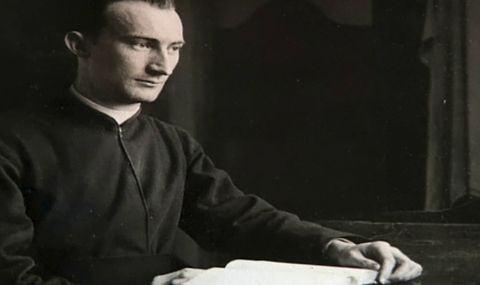
A fellow student described Franjo Šeper as a disciplined and methodical person: he never said too much, but what he did say was measured and clear.

A young priest in a black cassock sits at a table over an open book, looking aside.
At the desk · frame from the film

Cardinal Franjo Kuharićthen a seminarian

As rector of the Archdiocesan Theological Seminary in Zagreb, he was described by one of his students, the future Cardinal Franjo Kuharić, as serious and conscientious in his duties, yet close to the students. Because he was simple and approachable, students spoke with him without nerves: whatever the subject, the conversation was always human, humane.

The conversation was always human, humane.

as recalled by Cardinal Franjo Kuharić

Trnje, 1951–1954

Franjo Šeper’s encounters with the parishioners of Christ the King in Trnje, Zagreb, where he served from 1951 to 1954, showed his exceptional compassion for poor families, whom he also helped.

Alojzije Stepinacas told to Vraneković, parish priest of Krašić

When Šeper was consecrated archbishop, Stepinac told Vraneković, the parish priest of Krašić, that the Archdiocese of Zagreb was now in safe hands.
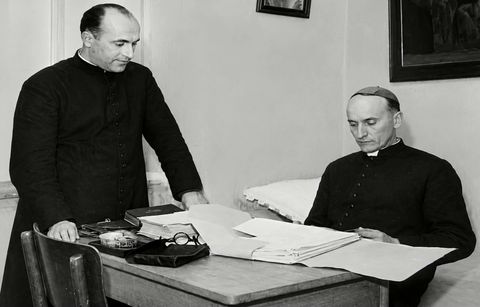
Two priests in a room: one stands by a table covered with papers, the other sits and reads.
Stepinac and Šeper · frame from the film

Zagreb, 1960–1969

As Archbishop of Zagreb, in times unfavourable to the Church, he was cautious but also inventive: he knew how to make pastoral work possible despite the restrictions, and organised churches in flats across Novi Zagreb.

At that time he asked candidates for the priesthood for a solemn promise not to join the regime’s professional association of priests, because he had seen what the regime was capable of.

Despite times unfavourable to the Church, Šeper also knew how to build bridges, without compromising the faith but avoiding needless conflict.
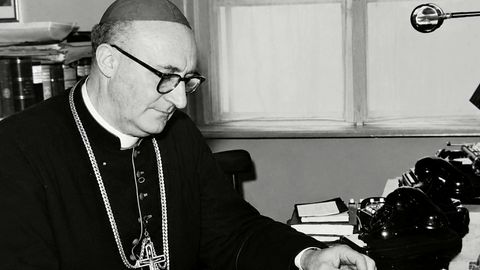
Archbishop Šeper at a desk with several telephones, looking at the papers in front of him.
In the office · frame from the film

Remete

The Carmelites, too, will always remember him with gratitude: as Archbishop of Zagreb he made possible the founding of the first Carmelite monastery in Croatia, at Remete in Zagreb, and for the first time entrusted them with a parish in Croatia, which they still run today.
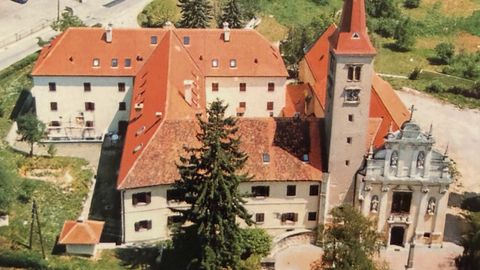
Aerial view of the monastery and church at Remete: red roofs, a bell tower and a baroque façade.
Remete · the first Carmelite monastery in Croatia · frame from the film

The Council, 1962–1965

At the Second Vatican Council he stood out for interventions marked by a calming tone and a gift for finding common ground. He belonged to the moderately progressive current that prevailed at the Council and shaped the character of its documents. Cardinal Šeper held that the renewal of the Church does not mean abandoning doctrine, but understanding it more deeply and passing it on more easily.

He also took part in shaping the Decree on Ecumenism, the document that opened new doors to dialogue among Christians. He combined firmness in faith with readiness for dialogue.

Rome, 1968–1981

As Prefect of the Sacred Congregation for the Doctrine of the Faith, to which Pope Paul VI appointed him in 1968, he proved a man who brought people together: a man of cooperation, of dialogue and of friendship among the bishops. Cardinal Šeper was not a man of drastic cuts, but he did not allow doctrine to be relativised: he talked, he listened to arguments, but once he had decided, the decision was final. Šeper’s “signature” on the documents of that time bears the mark of a balance between doctrinal clarity and pastoral care.
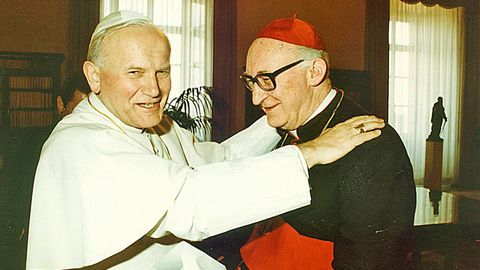
Pope John Paul II and Cardinal Šeper in a warm embrace, both smiling.
With Pope John Paul II · colourised photograph · frame from the film

Mgr Vladimir Stankovićhis secretary of many years

According to his secretary of many years, Mgr Vladimir Stanković, Cardinal Šeper was at heart a true “Zagrepčanec”, a man of Zagreb: he loved Zagreb above all, though he had travelled the whole world.
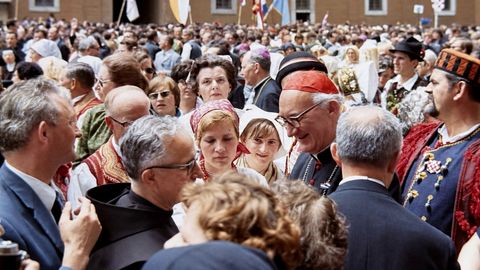
Cardinal Šeper in a crowd of the faithful, among them women in folk costume.
Among the faithful · colourised photograph · frame from the film

He left quietly, as he had lived. Without pomp, but leaving a deep mark.

Cardinal Šeper is remembered as a guardian of the faith at a time when the foundations seemed uncertain. His life bears witness that the strength of the Church lies not in noise and conflict, but in calm and steadfast witness.

Faith is not a wall that separates us from the world, but a bridge that connects us to it.

Letter

A collection of documentary films

Great Figures of the Church in Croatia

4 lives. 4 testimonies. 5 films. More than 6 hours of history worth preserving.

For the first time in one place: unique film and archive material on the great figures of the Church in Croatia and on Croatian saints, blesseds and martyrs.

Films in the collection

  1. Franjo Šeper the film on this site

    The man who rose from Zagreb to the very top of the Holy See.

    The first film ever made about Franjo Šeper, Archbishop of Zagreb and cardinal: his life, his service to the Church and his historic role as the first Croatian to head the Congregation for the Doctrine of the Faith.

    Cardinal Franjo Šeper
  2. Alojzije Stepinac

    A faith that did not bow to political pressure.

    Through archive footage and testimonies, discover the life, work and suffering of Blessed Alojzije Stepinac, one of the strongest witnesses of faith in Croatian history.

    Cardinal Alojzije Stepinac
  3. Franjo Kuharić

    A voice of kindness, hope and forgiveness in hard times.

    The life and messages of Cardinal Franjo Kuharić, a pastor whose words and example shaped the Church in Croatia in the second half of the 20th century.

    Cardinal Franjo Kuharić
  4. Nikola Eterović

    From the island of Brač to the highest offices of the Holy See.

    The life of Archbishop Nikola Eterović and his wide experience in the Church and in diplomacy on the international stage.

    Archbishop Nikola Eterović
  5. Holy Croatia

    People who lived their faith to the end.

    The story of Croatian saints, blesseds and martyrs, witnesses of faith whose lives still inspire today. The film brings valuable material on their legacy and their place in Croatian Church history.

    Saint Leopold Bogdan MandićA nun holding a crucifixPortrait of a young man in a suitA priest in a surplice

More than 6 hours of valuable content

5 documentary films · unique archive material · history · faith · testimony

A collection not only for watching, but for keeping, learning from and passing on to future generations.

Excellent material for religious education, schools, parishes, libraries, families and anyone who wants to know more about Croatia’s Church and national heritage.

Letter from Jakov Sedlar

Dear Sir or Madam,

For years, people from many places have asked us where they can find films of religious and spiritual content that serve as a reminder, and as proof, of how much the highest Croatian Church dignitaries did to preserve the faith and Croatian national identity. We have therefore decided to put five films that bear witness to exactly that on a single USB stick. The immediate occasion is the newly completed film about Cardinal Franjo Šeper, who held the highest office of any Croatian Church dignitary in the history of the Holy See: Prefect of the Congregation for the Doctrine of the Faith. With him, Cardinal and Blessed Alojzije Stepinac, Cardinal Franjo Kuharić and Archbishop Nikola Eterović, we are convinced that the right choice has been made. Alongside this magnificent quartet, the fifth film, “Holy Croatia”, tells of all the Croatian saints, blesseds and martyrs.

We believe that these four great figures of recent history can be an excellent example to new generations, who may find much that is good to inspire them in their lives and fates.

This unique six-hour collection of films is also well suited to religious education, and we hope it will be well received in many Croatian parish communities.

One USB stick costs €30, and the net proceeds will go towards new films with similar aims. Given the devotion to the Mother of God among the Croatian people, the first will be a film about Croatian Marian shrines.

You can order the USB stick by e-mail at
hrvatski.velikani52@gmail.com
or by mobile phone on
+385 91 951 1283

If you like the reason this USB was made, please recommend it to your friends.

Thank you!

Jakov Sedlar